Atlantic Biomass, LLC Announces Duel Pathway System to Affordably Produce Sustainable Aviation Fuels (SAF) and Renewable Bioproducts
PR Newswire
FREDERICK, Md., Feb. 18, 2026
Feedstocks are Perennial Grasses and other Renewable Biomass Sources
FREDERICK, Md., Feb. 18, 2026 /PRNewswire/ -- Do you know why passenger and freight planes are not using renewable biofuel? It's a simple reason - it costs too much.
"Converting stems and leaves from sustainable biomass into high-energy liquid fuels is not easy," says Atlantic Biomass President Bob Kozak. "And right now it's expensive."
So, Atlantic Biomass, LLC and our partners; The Ohio State University and Hood College, with funding assistance from Phase I of the Department of Energy Small Business Technology Transfer (STTR) program* and the Maryland Energy Innovation Institute (MEII), took apart the whole biomass-to-biofuel system to find an affordable way forward. "We started by testing each process. Found out the limits and hidden benefits. It was hard work," Kozak continued.
"Instead of focusing on individual steps, we decided to look at biofuel production as a complex system that needed to be understood," Kozak pointed out. "We looked for feedback loops and possibilities for multiprocessing. We found some that would lower costs and we put it all back together in a simplified Dual Pathway system."
How does it work?
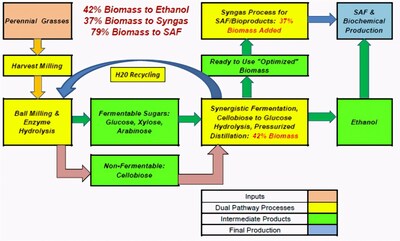
The Atlantic Biomass integrated biomass-ethanol-SAF process, which was the original focus of our work, can simultaneously be used to produce a high purity SAF syngas feedstock. This creates a Dual Pathway system that can nearly double biomass to SAF yields from about 42 percent to 79 percent without adding biomass cleaning, syngas scrubbing, or other processing costs.
Four key discoveries power the Dual Pathway system.
- Simultaneous ball milling and enzyme hydrolysis eliminates the need for costly thermo and chemical pretreatment to convert carbohydrates to sugars.
- Enzyme activity started during ball milling continues downstream. Combined with fermentation, it is able to remove inhibitions that prevent the conversion of a key biomass intermediate, cellobiose, to fermentable glucose without increasing processing costs.
- The combined processes required for ethanol production also produce a low impurity syngas feedstock. This overcomes purity and heterogeneous compositions issues that currently limit the economics of using harvested biomass for syngas production.
- Increasing the ratio of the diameter of a ball milling vessel to the length of perennial grass biomass to above a discovered value, converts most of the input biomass to a slurry containing fermentable sugars in a 24 hour cycle.
Use of the Dual Pathway System
The US Department of Energy 2023 Billion Ton Report shows that just in the US, perennial grasses have the potential to produce 284-535 million tons/year of biofuel biomass ready for processing. By partnering with existing ethanol and syngas based SAF installations, our system would be able to produce over 1 million barrels/day of affordable and sustainable renewable jetfuel from these grasses. "That would be just about enough to fuel every US commercial and freighter flight with US produced renewables. Think what a difference that could make," said Kozak.
In addition, portable versions of the Dual Pathway system can be forward deployed to key indigenous grass growing regions worldwide to produce ethanol and syngas to feed into European or Asian SAF production facilities. "We think it would bring sustainable economic and environmental benefits to countries around the Pacific and well as central Europe and Asia," continued Kozak. "We look forward to the opportunity of putting together joint ventures with SAF and agricultural organizations throughout the world."
Sustainable and Profitable Economics of the Dual Pathway System
The combination of the ethanol-to-SAF and syngas-to-SAF pathways in one system offers the cost-saving economics of vertical integration.
Atlantic Biomass Dual Pathway System
This business arrangement, pioneered by John D. Rockefeller, the founder of Standard Oil, would produce maximum synergy savings by fine-tuning enzyme loads, processing times, and other production parameters without worrying about intermediate conditions or transfer fees. "The scientists and engineers working with the system will be able to see it as one continuous stream. They won't have to worry about filling out forms or waiting for permission to test possible improvements," stated Kozak.
Estimated Dual Pathway Costs and Revenues
The Dual Pathway system will maximize profit potential by using the costs of ethanol-to-SAF production; ball milling, fermentation, distillation, to also produce the high-purity feedstock needed for syngas production. This provides a major profit increase over stand-alone biomass-ethanol-SAF systems as shown in the following table. Estimates in this table are presented on a per acre basis. This allows for easier comparisons of projects based on available acreage.
Dual Pathway Estimated Production Cost and Revenue Streams
Compared to Only Ethanol to SAF
Ethanol to SAF Pathway | Twin Pathway: Ethanol | ||
1 | SAF from Ethanol: Gallons/Acre | 280 | 280 |
2 | SAF Wholesale Price | $4.25 | $4.25 |
3 | SAF Income/Acre2 | $1,190.00 | $1,190.00 |
4 | Grass Price/Acre1 | $500.00 | $500.00 |
5 | Ethanol & SAF Refining Costs/Gallon SAF | $1.80 | $1.80 |
6 | Ethanol & SAF Refining Costs/Acre | $504.00 | $504.00 |
7 | Total Production Costs/Acre SAF | $1,004.00 | $1,004.00 |
8 | Net SAF Income/Acre | $186.00 | $186.00 |
9 | Syngas Production Tons/Acre | 3.7 | |
10 | Syngas (gallons equivalent)/Acre | 607 | |
11 | Syngas Wholesale/Gallon | $4.00 | |
12 | Syngas Income/Acre | $2,429 | |
13 | Syngas Production Costs/Acre | 516.12 | |
14 | Net Syngas SAF Income | $1,913 | |
15 | Net Income Ethanol and Syngas SAF/Acre | $186.00 | $2,098.68 |
1Current low-scale switchgrass for animal bedding prices run $250-300/acre.
2 SAF prices are used to represent the value of the fuel and related biochemical products. All attempts have been made to present estimates based on published prices and Phase I production estimates. Calculations for some production estimates used proprietary information that can be shared under proper agreements. All numbers presented are estimates at this time and should not be used for business agreements.
Are You Ready for Take-Off?
An illustrated version of this press release as well as detailed R&D results and additional information is available from Atlantic Biomass, LLC.
Atlantic Biomass, LLC, a small business located in Frederick, Maryland is focused on the development and commercialization of proprietary enzymatic-based biomass "deconstruction" processes. These processes allow the use of low-cost, non-food biomass as feedstocks for renewable sustainable biofuels and bioproducts. Processes developed convert perennial grasses, hemp biomass, and sugar beet pulp into the building blocks for biofuels and other bioproducts, as well as dandelions for rubber.
* Note: Unfortunately the DOE SBIR/STTR program no longer exists. It was abolished in FY 2026 DOE appropriations
 View original content to download multimedia:https://www.prnewswire.com/news-releases/atlantic-biomass-llc-announces-duel-pathway-system-to-affordably-produce-sustainable-aviation-fuels-saf-and-renewable-bioproducts-302691926.html
SOURCE Atlantic Biomass, LLC

